


 PLATFORM UPDATE:


New insight into the catalytic mechanism of ester hydrogenation over the Cu/ZnO catalyst: the contribution of hydrogen spillover

Abstract
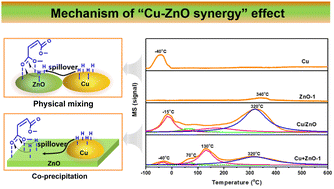
The dimethyl maleate hydrogenation activity of Cu, ZnO-X and physically mixed Cu+ZnO-X samples was systematically investigated to probe the essential role of ZnO in ester hydrogenation processes. Cu samples exhibited high C![[double bond, length as m-dash]](https://www.rsc.org/images/entities/char_e001.gif) C bond hydrogenation ability with dimethyl succinate as the main product. Comparatively, ZnO was inactive in hydrogenation due to its weak ability to dissociate hydrogen while the CO group could be activated and adsorbed on the ZnO surface. Interestingly, physical mixing with ZnO significantly improved the CO hydrogenation activity of Cu samples. The H2-TPD results reveal the origin of “Cu–ZnO synergy”: hydrogen atoms formed on the copper surface can spill over to the ZnO surface and react with the adsorbed CO group.
C bond hydrogenation ability with dimethyl succinate as the main product. Comparatively, ZnO was inactive in hydrogenation due to its weak ability to dissociate hydrogen while the CO group could be activated and adsorbed on the ZnO surface. Interestingly, physical mixing with ZnO significantly improved the CO hydrogenation activity of Cu samples. The H2-TPD results reveal the origin of “Cu–ZnO synergy”: hydrogen atoms formed on the copper surface can spill over to the ZnO surface and react with the adsorbed CO group.
 Please wait while we load your content...


