


 PLATFORM UPDATE:

Specific capacitance of graphene oxide–metal interfaces at different deoxygenation levels†

Abstract
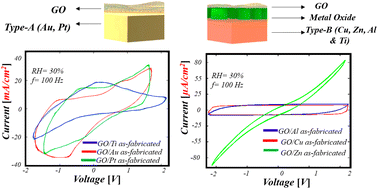
The experimental data available on the electrical features of graphene oxide/metal (GO/M) interfaces appear sporadic and inconsistent. Here, we fuse the findings from nanostructural and electrical characterization studies on various M/GO/M structures at different GO deoxygenation levels and conclude for the first time that the impedance of an M/GO/M structure is mainly determined by the GO/M interface and strongly depends on the nature of M. Based on our results, GO/M interfaces are categorized into two distinct types: A-types, including GO/Au and GO/Pt, depict a specific capacitance of 0.1 mF cm−2, while B-types, including GO/Cu, GO/Al, and GO/Zn, present SCs in the 10 nF cm−2 range. It is established for the first time that capacitances of the A-types are intrinsically related to the interface, while the growth of nanostructured metal oxides/hydroxides at the B-type interfaces controls their capacitances. The oxygen content of the interface-grown mass is considerably more than the total oxygen on the deposited GO. Hence, the growth mechanism is linked to the dissociation of water in the nano-reactors formed at these interfaces. A case study experimentally designates 10 μF cm−2 to GO/Ti interfaces, regardless of its electrochemical similarities to the B-types. This observation is described based on the unique properties of interface-grown Ti-rich oxide layers. Understanding the redox reactions taking place in the nano-reactors formed at GO/M interfaces can lead to novel electronic and electrochemical applications. Our findings are anticipated to initiate research on the electrical properties of GO interfaces with other metals.
 Please wait while we load your content...


