


 PLATFORM UPDATE:

Multi-dynamics and emission tailored fluoroperovskite-based down-conversion phosphors for enhancing the current density and stability of the perovskite solar cells†

Abstract
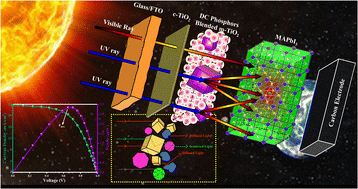
State-of-the-art and innovative research is being intensively employed on perovskite solar cells (PSCs) to expand their frontiers further. This study is a successful attempt to drive the limit of photocurrent density (Jsc) beyond conventional PSCs (which typically utilize the visible spectrum alone) through a nonlinear optical phenomenon called down-conversion (DC). The use of DC luminescence to harness the UV region from the solar spectrum is explored by utilizing Eu3+ activated RbCaF3, a fluoroperovskite-based phosphor material. It is observed that PSCs, which used RbCaF3:Eu3+ incorporated TiO2 electron transport layer (ETL), enhanced their Jsc and UV stability compared to those with pristine TiO2-oriented ETL. Such improvement in the aforementioned devices is due to the result of converting high-energy UV photons to effectively absorbable low-energy visible photons for perovskite absorbers. Overall, the DC-aided PSC offered a substantial Jsc of 23.54 mA cm−2 (9.2% superior to the conventional PSC) and boosted its power conversion efficiency (PCE) from 11.2% to 13.3%. It is evident that DC-based PSCs show a much better shelf-life when compared to conventional PSCs. This unique approach for boosting the Jsc with enhanced stability can be utilized for the potential applications of PSCs.
 Please wait while we load your content...


