


 PLATFORM UPDATE:

Deactivation of macroporous ion-exchange resins by acetonitrile and inhibition by water in the simultaneous synthesis of ethyl tert-butyl ether (ETBE) and tert-amyl ethyl ether (TAEE)

Abstract
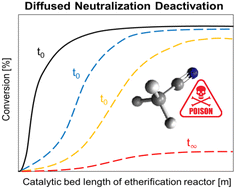
The deactivating effect of acetonitrile (ACN) and ACN/water mixtures on the feed stream has been investigated for the simultaneous syntheses of ethyl tert-butyl ether (ETBE) and tert-amyl ethyl ether (TAEE) over the ion-exchange resins Amberlyst™35 (A-35) and Purolite®CT-275 (CT-275). Experiments were performed in a fixed bed catalytic reactor free of mass transfer effects. The explored range of temperature was 313–353 K and ACN concentrations in the ethanol feed stream ranged from 0–4000 ppm. The deactivation effect of ACN was similar for A-35 and CT-275. Two different periods are distinguished in the deactivation evolution: an initial stage in which activity does not decrease, due to the release of previously adsorbed water, followed by an exponential-like activity decay, due to the neutralization of active sites by ACN-derived compounds. Deactivation is favored by poison concentration and temperature, following a selective poisoning pattern through which the most accessible sites are neutralized readily. Several deactivation kinetic models have been tested to describe the activity loss, the best being a first order model. The estimated activation energy for the overall deactivation process is 33.1 ± 1.4 kJ mol−1. In addition, the inhibitory effect of water at concentrations from 1000 to 5000 ppm has been evaluated finding that models based on Langmuir and Freundlich isotherms can describe the experimental observations.
 Please wait while we load your content...


