


 PLATFORM UPDATE:

Synergistic effect of coordinating interface and promoter for enhancing ammonia synthesis activity of Ru@N–C catalyst†
 *a
Bin
Hu
*a
*a
Bin
Hu
*a
Abstract
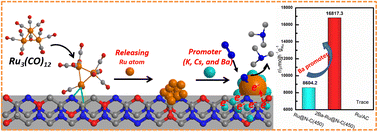
Triruthenium dodecacarbonyl (Ru3(CO)12) was applied to prepare the Ru-based ammonia synthesis catalysts. The catalyst obtained from this precursor exhibited higher activity than the other Ru salts owing to its unique atomic reorganization under mild temperatures. Herein, Ru3(CO)12 as a guest metal source incorporated into the pore of ZIF-8 formed the Ru@N–C catalysts. The results indicated that the Ru nanoparticle (1.7 nm) was dispersed in the confined N coordination environment, which can increase the electron density of the Ru nanoparticles to promote N![[triple bond, length as m-dash]](https://www.rsc.org/images/entities/char_e002.gif) N bond cleavage. The promoters donate the basic sites for transferring the electrons to Ru nanoparticles, further enhancing ammonia synthesis activity. Ammonia synthesis investigations revealed that the obtained Ru@N–C catalysts exhibited obvious catalytic activity compared with the Ru/AC catalyst. After introducing the Ba promoter, the 2Ba–Ru@N–C(450) catalyst exhibited the highest ammonia synthesis activity among the catalysts. At 360 °C and 1 MPa, the activity of the 2Ba–Ru@N–C(450) is 16 817.3 µmol h−1 gRu−1, which is 1.1, 1.6, and 2 times higher than those of 2Cs–Ru@N–C(450) (14 925.4 µmol h−1 gRu−1), 2K–Ru@N–C(450) (10 736.7 µmol h−1 gRu−1), and Ru@N–C(450) (8604.2 µmol h−1 gRu−1), respectively. A series of characterizations were carried out to explore the 2Ba–Ru@N–C(450) catalysts, such as H2-TPR, XPS, and NH3-TPD. These results suggest that the Ba promoter played the role of an electronic and structural promoter; moreover, it can promote the NH3 desorption from the Ru nanoparticles.
N bond cleavage. The promoters donate the basic sites for transferring the electrons to Ru nanoparticles, further enhancing ammonia synthesis activity. Ammonia synthesis investigations revealed that the obtained Ru@N–C catalysts exhibited obvious catalytic activity compared with the Ru/AC catalyst. After introducing the Ba promoter, the 2Ba–Ru@N–C(450) catalyst exhibited the highest ammonia synthesis activity among the catalysts. At 360 °C and 1 MPa, the activity of the 2Ba–Ru@N–C(450) is 16 817.3 µmol h−1 gRu−1, which is 1.1, 1.6, and 2 times higher than those of 2Cs–Ru@N–C(450) (14 925.4 µmol h−1 gRu−1), 2K–Ru@N–C(450) (10 736.7 µmol h−1 gRu−1), and Ru@N–C(450) (8604.2 µmol h−1 gRu−1), respectively. A series of characterizations were carried out to explore the 2Ba–Ru@N–C(450) catalysts, such as H2-TPR, XPS, and NH3-TPD. These results suggest that the Ba promoter played the role of an electronic and structural promoter; moreover, it can promote the NH3 desorption from the Ru nanoparticles.
 Please wait while we load your content...


