


 PLATFORM UPDATE:

Ultrasonic spray pyrolysis synthesis of TiO2/Al2O3 microspheres with enhanced removal efficiency towards toxic industrial dyes

Abstract
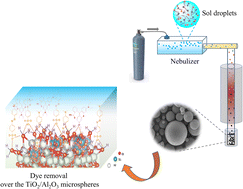
Developing low-cost and highly effective adsorbent materials to decolorate wastewater is still challenging in the industry. In this study, TiO2-modified Al2O3 microspheres with different TiO2 contents were produced by spray pyrolysis, which is rapid and easy to scale up. Results reveal that the modification of γ-Al2O3 with TiO2 reduced the crystallite size of Al2O3 and generated more active sites in the composite sample. The as-synthesized Al2O3–TiO2 microspheres were applied to remove anionic methyl orange (MO) and cationic rhodamine B (RB) dyes in an aqueous solution using batch and continuous flow column sorption processes. Results show that the Al2O3 microspheres modified with 15 wt% of TiO2 exhibited the maximum adsorbing capacity of ∼41.15 mg g−1 and ∼32.28 mg g−1 for MO and RB, respectively, exceeding the bare γ-Al2O3 and TiO2. The impact of environmental complexities on the material's reactivity for the organic pollutants was further delineated by adjusting the pH and adding coexisting ions. At pH ∼5.5, the TiO2/Al2O3 microspheres showed higher sorption selectivity towards MO. In the continuous flow column removal, the TiO2/Al2O3 microspheres achieved sorption capacities of ∼31 mg g−1 and ∼19 mg g−1 until the breakthrough point for MO and RB, respectively. The findings reveal that TiO2-modified Al2O3 microspheres were rapidly prepared by spray pyrolysis, and they effectively treated organic dyes in water in batch and continuous flow removal processes.
 Please wait while we load your content...


