


 PLATFORM UPDATE:


Quantitative evaluation of the actual hydrogen atom donating activities of O–H bonds in phenols: structure–activity relationship†
 *a
Guang-Bin
Shen
b
and
*a
Guang-Bin
Shen
b
and
Abstract
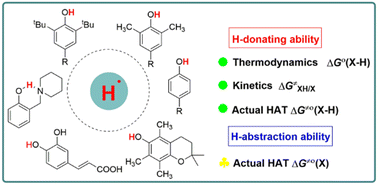
The H-donating activity of phenol and the H-abstraction activity of phenol radicals have been extensively studied. In this article, the second-order rate constants of 25 hydrogen atom transfer (HAT) reactions between phenols and PINO and DPPH radicals in acetonitrile at 298 K were studied. Thermo-kinetic parameters ΔG≠o(XH) were obtained using a kinetic equation [ΔG≠XH/Y = ΔG≠o(XH) + ΔG≠o(Y)]. Bond dissociation free energies ΔGo(XH) were calculated by the iBonD HM method, whose details are available at https://pka.luoszgroup.com/bde_prediction. Intrinsic resistance energies ΔG≠XH/X and ΔG≠o(X) were determined as ΔG≠o(XH) and ΔGo(XH) were available. ΔGo(XH), ΔG≠XH/X, ΔG≠o(XH) and ΔG≠o(X) were used to assess the H-donating abilities of the studied phenols and the H-abstraction abilities of phenol radicals in thermodynamics, kinetics and actual HAT reactions. The effect of structures on these four parameters was discussed. The reliabilities of ΔG≠o(XH) and ΔG≠o(X) were examined. The difference between the method of determining ΔG≠XH/X mentioned in this study and the dynamic nuclear magnetic method mentioned in the literature was studied. Via this study, not only ΔGo(XH), ΔG≠XH/X, ΔG≠o(XH) and ΔG≠o(X) of phenols could be quantitatively evaluated, but also the structure–activity relationship of phenols is clearly demonstrated. Moreover, it lays the foundation for designing and synthesizing more antioxidants and radicals.
 Please wait while we load your content...


