


 PLATFORM UPDATE:

Phonon mechanism of angle-dependent superlubricity between black phosphorus layers
 *ab
*ab
Abstract
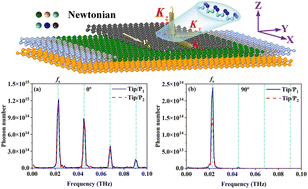
Based on a combination of molecular dynamics simulations and quantum theories, this study discloses the phonon mechanism of angle-dependent superlubricity between black phosphorus layers. Friction exhibits 180° periodicity, i.e., the highest friction at 0° and 180° and lowest at 90°. Thermal excitation reduces friction at 0° due to thermal lubrication. However, at 90°, high temperature increases friction caused by thermal collision owing to lower interfacial constraints. Phonon spectra reveal that with 0°, energy dissipation channels can be formed at the interface, thus enhancing dissipation efficiency, while the energy dissipation channels are destroyed, thus hindering frictional dissipation at 90°. Besides, for both commensurate and incommensurate cases, more phonons are excited on atoms adjacent to the contact interface than those excited from nonadjacent interface atoms.
 Please wait while we load your content...


