


 PLATFORM UPDATE:

Impact of copper immobilization on dramatic conversion of inactive NiAlFeO4 to an active catalyst for reduction of nitrophenols and a visible light photocatalyst for effective removal of organic contaminants from waste water

Abstract
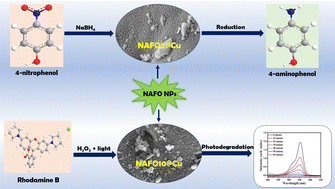
Due to their carcinogenic, mutagenic and poisonous nature, industrial wastes such as metals, dyes, polycyclic aromatic hydrocarbons, surfactants and pharmaceutical waste have become a major worldwide issue for human health. In this context, we are reporting the synthesis, characterization and application of copper-immobilized nanocomposites NiAlFeO4@Cu for catalytic reduction of hazardous and carcinogenic nitrophenols and photocatalytic degradation of different dyes (rhodamine B (RhB), methyl orange (MO) and methylene blue (MB)), individually as well as their mixture under visible light irradiation. Magnetically separable mesoporous composites of NiAlFeO4 and copper nanoparticles in the molar ratios of 2 : 1 (NAFO2@Cu), 5 : 1 (NAFO5@Cu) and 10 : 1 (NAFO10@Cu) were prepared through a simple reduction method with pure water as the solvent. The structural, morphological and physicochemical features of the prepared nanocatalysts were examined using PXRD, FE-SEM, PL, DRS, VSM and BET. The nanocomposites were found to be very porous and spherical with an average crystallite size between 4 and 8 nm. Magnetic measurements were carried out using a vibrating sample magnetometer, which reveal the ferromagnetic nature of our samples, making them magnetically separable. A UV/Vis study was used to analyse the reduction of nitrophenols by employing sodium borohydride as a reducing agent. Furthermore, the band gap energy values of the nanocomposites were found to be in the visible range (1.63–1.66 eV) making them suitable for photocatalysis. Rhodamine B was used as a model dye pollutant for estimation of the photocatalytic deterioration of the synthesized nanocatalysts. Among all the prepared nanocomposites, NAFO2@Cu exhibited the highest catalytic efficiency for the reduction of nitrophenols, while the maximum degradation efficiency was shown by NAFO10@Cu for the photodegradation of different dyes individually as well as in their ternary solution.
 Please wait while we load your content...


