


 PLATFORM UPDATE:

Calotropis procera flower extract for the synthesis of double edged octahedral α-Fe2O3 nanoparticles via a greener approach: an insight into its structure property relationship for Escherichia coli†
 *ab
*ab
Abstract
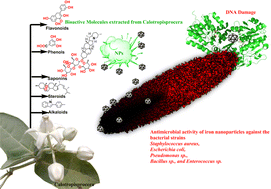
Urinary tract infection caused by Escherichia coli (E. coli) is regarded as one of the most serious issues confronting humans worldwide. However, the antibacterial mechanism and process are time-consuming and inconclusive. To address this issue, iron oxide-based antibacterial agents were synthesized in a more environmentally friendly greener approach using an Indian traditional flower extract from the Calotropis procera plant, which contains several bioactive secondary metabolic moieties. Powder X-ray diffraction (PXRD) techniques confirm the formation of α-Fe2O3 crystal packing in green synthesized nanoparticles (NPs) from its crystal planes (012, 104, 110, 113, 024, 116, 018, 214, and 300). High-resolution scanning electron microscopy (HR-SEM) was used to examine the morphology of α-Fe2O3 NPs, which revealed a double layer edge-octahedral (DLE-Oh) shape with an average edge length of ∼4.0 nm, corresponding to surface area ∼55.42 nm2, and volume ∼221.70 nm3 as calculated. The synthesized α-Fe2O3 DLE-OH NPs have effective antibacterial activity against E. coli, with a high rate of inhibition observed. Furthermore, the various iron oxide hierarchal structures for E. coli membrane proteins were optimized using density functional theory. Molecular docking studies show that the lowest inhibition constant (Ki) values, such as 33.40 and 2.24 μM for 2MEQ and 6ZHP membrane proteins, effectively inhibit bacterial replication.
 Please wait while we load your content...


