


 PLATFORM UPDATE:

Cobalt(ii)–curcumin cysteine conjugate as c-MYC promoter G-quadruplex selective switch-on fluorescence probe†

Abstract
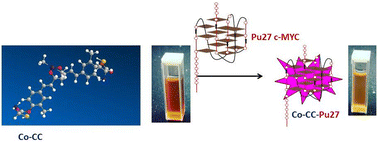
We have synthesized a metal organic framework comprising a cobalt(II) complex of a curcumin–cysteine conjugate (i.e., Co–CC) as a fluorescent probe for the detection of G-quadruplex DNA sequences. The as-synthesized probe has been characterized using different spectroscopic and microscopic methods. The strong fluorescence emission of the Co–CC probe was noticed upon sequential addition of different guanine-rich DNA sequences without the appearance of any new absorption band. Among the different DNA sequences, the probe showed better selectivity and a significantly lower detection limit for the c-MYC hypersensitivity element Pu-27 (i.e., LOD: 8.61 ± 1.96 nM) and quantification detection limit (28.72 nM). Further, cytotoxicity analysis was performed with A549 human carcinoma lung cancer cells and ATCC CCL-81 Vero cells. This study reveals that the as-synthesized Co–CC has improved cytotoxicity toward A549 lung cells and mild toxicity toward Vero cells when compared to pristine curcumin. Real-world sample analysis also showed an encouraging result, with a recovery range of 101 to 104%. As a result, the current study provides insights for further improving bioavailability through metal–organic ligand complexation and Co–CC could be used for in vivo analysis as well.
 Please wait while we load your content...


