


 PLATFORM UPDATE:

Effective paracetamol sensor activity, thermal barrier coating (TBC), and UV-light-driven photocatalytic studies of ZrxO2:Mg2+(1−x) nanoparticles

Abstract
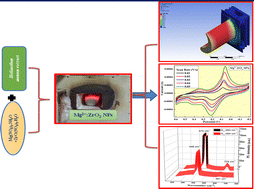
Herein, we report the synthesis of magnesia co-stabilized zirconia (ZrO2:Mg2+) NPs by a green (Helianthus annuus plant leaves extract) combustion route and their tailored characteristics for thermal barrier coating (TBC) applications. TBCs were accomplished by coating ZrO2:Mg2+ NPs on the surface of an IC engine using a plasma spread coating technique and the heat transfer reduction properties were investigated. The results revealed excellent thermal insulation properties. Photocatalytic studies were conducted on the host and doped NPs (5 mol%) for the photodegradation of Acid Green (AG) dye and 74.46% and 88% were achieved, respectively, at a 105 min time interval under irradiation by UV-Visible light. The photoluminescence (PL) emission properties of Mg-doped ZrO2 NPs were reported by monitoring the excitation wavelengths of 264 and 283 nm at RT and they were efficiently used in display applications. The excellent capacitance measurements for the ZrO2:Mg2+-graphite paste electrode were observed by CV and EIS techniques in a 3-electrode system using 0.1 M HCl electrolytic solution. CV studies confirmed the potential activity towards the measurement of the thermodynamics of the redox reaction and capacitance of the prepared material carried out by cycling the potential of the prepared ZrO2:Mg2+-graphite working electrode at different scan rates in the range 0.01–0.05 V s−1 at room temperature. This study extended towards chemical sensing applications and excellent paracetamol sensor activities were reported for Mg-doped ZrO2 NPs.
 Please wait while we load your content...


