


 PLATFORM UPDATE:

Scalable synthesis of Ti3C2Tx–arginine and serine-functionalized carbon quantum dot microspheres for high performance supercapacitors†
 *a
*a
Abstract
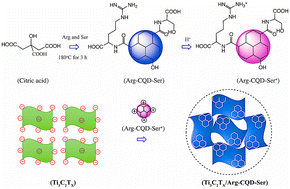
MXene aerogels have become promising electrode materials for supercapacitors because of their excellent conductivity and processability; however, the scalable synthesis of the MXene aerogels still faces a great challenge. The study reports the synthesis of Ti3C2Tx MXene-arginine and serine-functionalized carbon quantum dot aerogel microspheres (Ti3C2Tx/Arg-CQD-Ser). Positively-charged Arg-CQD-Ser was prepared by the pyrolysis of citric acid, arginine, and serine and subsequent protonation with hydrochloric acid. The formed Arg-CQD-Ser was mixed with Ti3C2Tx in water to form Ti3C2Tx–Arg-CQD-Ser via electrostatic attraction. The introduction of Arg-CQD-Ser results in the formation of a three-dimensional structure and a Schottky heterojunction. The synthesis achieves an improved supercapacitor performance. Ti3C2Tx–Arg-CQD-Ser electrode exhibits a high specific capacitance of 525.0 F g−1 at a current density of 1.0 A g−1, which is more than 2.25-fold than that of the Ti3C2Tx electrode. The symmetric supercapacitor with the Ti3C2Tx–Arg-CQD-Ser electrode provides high specific capacitance (386.2 F g−1 at a current density of 1 A g−1), high-rate capacitance (182.4 F g−1 at a current density of 30 A F−1), cycling stability (capacity retention of 98.9% after 10 000 cycles at a current density of 5 A g−1), and energy density (20.9 W h kg−1 at a power density of 312.5 W kg−1). The study also paves the way for the synthesis of MXene composites in sensing, catalysis, and energy storage.
 Please wait while we load your content...


