


 PLATFORM UPDATE:

Rotors of BOSCHIBAs as endoplasmic reticulum fluorescent probes in HeLa and human umbilical vein endothelial cells†

Abstract
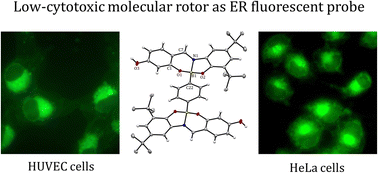
The fluorescence imaging technique is becoming a useful tool in the natural and life sciences. Commercial biomarkers are available; however, some disadvantages exist like high isolation cost, low-temperature storage, photodegradation, and low yields. Here two new fluorescent molecular rotors (SB-B 2 and SB-B2 3) derived from Boron Schiff bases (BOSCHIBAs) were synthesized and characterized by NMR (1H and 13C), UV/Vis, and fluorescence spectroscopy. The crystal structure of SB-B2 3 by X-ray diffraction showed a binuclear complex and C2 symmetry. Both compounds showed viscochromic and thermochromic properties. The binuclear rotor 3 showed a greater luminescence intensity increase than the mononuclear one at the highest level of viscosity (90%). From the remarkable findings and to our best knowledge this is the first time low cytotoxicity BOSCHIBAs exhibit selective fluorescent staining of endoplasmic reticulum in HeLa cells and HUVECs.
 Please wait while we load your content...


