


 PLATFORM UPDATE:


The coordination chemistry of 2,4,6-oxy functionalised 1,3,5-triphosphinines†

Abstract
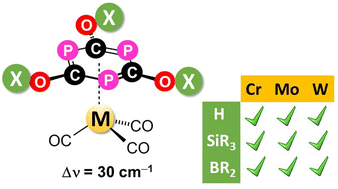
A number of stable group 6 metal complexes bearing 2,4,6-oxy functionalised 1,3,5-triphosphinines, phosphorus containing heterocyclic ligands with a central C3P3 core, were synthesised such that a complete series of [M{P3C3(OX)3}(CO)3] compounds is obtained [M = Cr(0), Mo(0), W(0); X = H, SitBuPh2, B(ipc)2]. In all complexes, the triphosphinine coordinates in a η6-binding mode via the delocalized 6π-system of the ring. The ligand properties can be tuned by changing the substituent on the oxygen centre. The π-electron accepting properties of the ligand increases in the following order: P3C3(OH)3 < P3C3(OSitBuPh2)3 < P3C3(OB(ipc)2)3. This trend is reflected in the structures determined by X-ray crystallography, and the ν(CO) stretching frequencies determined by IR spectroscopy. The collected data raise questions with respect to the frequently made assumption that phosphinines act as stronger π-acceptors with respect to arenes and thereby deplete electron density at the metal centres. With P3C3(OH)3 as an η6-coordinated ligand further molecules can be coordinated in the second coordination sphere via hydrogen bonds, which may be of interest for the construction of coordination polymers.
 Please wait while we load your content...


