


 PLATFORM UPDATE:


Two isostructural complexes of Ni(ii) and Zn(ii) with violurate and pyridine: a detailed structural, theoretical, magnetic, and NMR investigation†
 ab
Subrata
Das,
*c
Ján
Titiš,
*e
Roman
Boča,
e
Alexander M.
Kirillov,
*f
Alexander S.
Novikov,
gh
Ray J.
Butcher,
j
Antonio
Bauza
k
and
Antonio
Frontera
*k
ab
Subrata
Das,
*c
Ján
Titiš,
*e
Roman
Boča,
e
Alexander M.
Kirillov,
*f
Alexander S.
Novikov,
gh
Ray J.
Butcher,
j
Antonio
Bauza
k
and
Antonio
Frontera
*k
Abstract
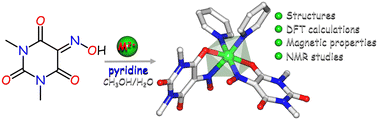
Two new metal(II) complexes [M(dmv)2(py)2]·3H2O {M = Ni (1), Zn (2)} were self-assembled from a metal(II) chloride salt, N,N′-dimethylvioluric acid (Hdmv), and pyridine (py). They were isolated as stable crystalline solids and characterized, including by single crystal X-ray diffraction. Structures 1 and 2 are composed of discrete [M(dmv)2(py)2] blocks in which the six-coordinate metal(II) atoms show a slightly distorted {MN4O2} octahedral geometry. The adjacent [M(dmv)2(py)2] units are hydrogen bonded with an involvement of disordered water clusters into 1D H-bonded chains. DFT calculations were used to analyse the unconventional anti-parallel C![[double bond, length as m-dash]](https://www.rsc.org/images/entities/char_e001.gif) O⋯CO interaction observed between the monomeric units in 1 and 2. Complex 1 also refers to an elongated tetragonal bipyramid for which a positive zero-field splitting is confirmed by magnetic studies. The complex matches the magnetostructural D-correlation for hexacoordinate Ni(II) complexes with moderate structural and magnetic anisotropy with Dstr = +7.45 pm, and Dmag = +5.11 cm−1. Solution state NMR spectroscopy reveals a slow isomerization process related to the bidentate-N,O and bidentate-O,O coordination of dimethylviolurate in 2, with the barrier ranging from 76.4 to 77.9 kJ mol−1. The 1H NMR spectra confirm the presence of three water molecules which exhibit significant chemical shift dependence on temperature indicating strong binding to the complex in solution phase.
O⋯CO interaction observed between the monomeric units in 1 and 2. Complex 1 also refers to an elongated tetragonal bipyramid for which a positive zero-field splitting is confirmed by magnetic studies. The complex matches the magnetostructural D-correlation for hexacoordinate Ni(II) complexes with moderate structural and magnetic anisotropy with Dstr = +7.45 pm, and Dmag = +5.11 cm−1. Solution state NMR spectroscopy reveals a slow isomerization process related to the bidentate-N,O and bidentate-O,O coordination of dimethylviolurate in 2, with the barrier ranging from 76.4 to 77.9 kJ mol−1. The 1H NMR spectra confirm the presence of three water molecules which exhibit significant chemical shift dependence on temperature indicating strong binding to the complex in solution phase.
 Please wait while we load your content...


