


 PLATFORM UPDATE:


Local structure regulation and spectroscopy study of blue cubic zirconia
 a
a
Abstract
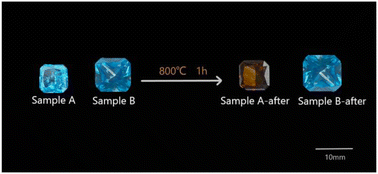
The high temperature stability of zirconia crystals is improved by regulating the content of the stabilizer Y2O3. Cubic zirconia crystals with thermal stability are one of the most active academic research areas for zirconia crystal materials. Nonetheless, the reason for the discoloration of blue cubic zirconia at high temperatures was not determined. In this paper, the spectra of yttria-stabilized zirconia (YSZ) were investigated, and the local structure regulation was carried out to determine the reasons for the colour instability of crystals at high temperatures. Two kinds of blue cubic zirconia samples with different ZrO2–Y2O3 ratios were heated at 800 °C for 1 hour in an air atmosphere. The structure, optical characteristics, and electron binding energy of cubic zirconia crystals with different ratios before and after heating were compared. Sample A changed colour, while sample B remained unchanged. The amount of Y2O3 stabilizers in sample A is three times higher than that in sample B. The significant shift in the absorption cut-off edge of sample A after heating indicates a reduction in the crystal bandgap. The high temperature discoloration of the crystals is attributed to an increase in oxygen vacancies. The study of XPS, XRD, and Raman showed an increase in the concentration of oxygen vacancies in sample A after heating. The thermoluminescence spectra indicate the depth of oxygen vacancy defects and the increase in defect concentration after heating.
 Please wait while we load your content...


