


 PLATFORM UPDATE:

Graphdiyne aerogel architecture via a modified Hiyama coupling reaction for gas adsorption†

Abstract
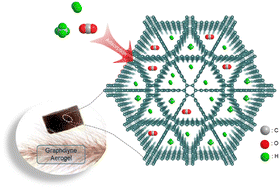
Carbon aerogels are special porous materials with low density and large specific surface area and have advanced applications. As a new type of carbon nanomaterials, graphdiynes (GDY) aerogel possess a highly π-conjugated structure, unique sp/sp2-hybridized linkages, and well-distributed intrinsic pores, which endow GDY aerogel with great potential applications. However, the fabrication of macroscopic GDY aerogel is still an ongoing challenge due to intrinsic synthetic difficulties. Here, a modified Hiyama coupling reaction was developed to synthesize GDY aerogel via in-situ deprotection of trimethylsilane groups and subsequent freeze-drying. The synthesized GDY aerogel has a low density of ∼12 mg cm−3, a high specific surface area of ∼909 m2 g−1, and a porosity of ∼98%, which is superior to other GDY nanomaterials. The adsorption capacity of GDY aerogel toward H2, CO2, and CH4 is investigated, and competitive adsorption abilities are obtained.
 Please wait while we load your content...


