


 PLATFORM UPDATE:

Insight into the relationship between redox ability and separation efficiency via the case of α-Bi2O3/Bi5NO3O7†

Abstract
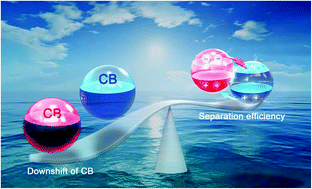
Constructing heterostructured photocatalysts will generally improve the separation efficiency of photo-induced carriers; however, the change in the energy band position that affects their redox ability has received little attention. In this work, α-Bi2O3/Bi5NO3O7 heterojunctions are prepared via solution combustion synthesis and characterized by UV-vis DRS, Mott–Schottky and Kelvin probes, and the band structures of α-Bi2O3 and Bi5NO3O7 before and after the formation of the heterojunction are obtained. The results of the degradation of rhodamine B and tetracycline indicate that the main active species are holes and superoxide anion radicals, respectively. Although separation efficiency over heterojunctions is higher than that over individual Bi5NO3O7 and α-Bi2O3, lower degradation ability is observed. The reason is that the heterojunction formation causes an upward shift of the valence band of Bi5NO3O7 and a downward shift of the conduction band of α-Bi2O3, which reduces the oxidation ability of holes and the ability to activate molecular oxygen, respectively. The decrease in the redox ability outweighs the positive impact of enhanced separation efficiency.
 Please wait while we load your content...


