Issue 37, 2022

A simple approach based on transmetalation for the selective and sensitive colorimetric/fluorometric detection of copper(ii) ions in drinking water

Abstract

The search for feasible and efficient methods for sensing cations in the environment is a challenge of current scientific interest. Among the colorimetric and fluorometric methods, those that enable the direct and rapid detection of the analytes are highly desirable. Here a simple approach based on the transmetalation of a Zn(II) Schiff-base complex for the selective and sensitive colorimetric and fluorometric detection of Cu2+ ions in aqueous solution is reported. This method offers the advantages of being direct, fast, and not requiring any treatment of the sample. A detection limit down to 0.60 μM is obtained from the spectrophotometric data. The method is demonstrated to be efficient for the quantitation of Cu2+ ions in drinking water.
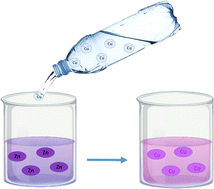
Graphical abstract: A simple approach based on transmetalation for the selective and sensitive colorimetric/fluorometric detection of copper(ii) ions in drinking water

Supplementary files

Article information

Article type
Paper
Submitted
26 Jul 2022
Accepted
23 Aug 2022
First published
23 Aug 2022
This article is Open Access
Creative Commons BY-NC license

New J. Chem., 2022,46, 18018-18024

A simple approach based on transmetalation for the selective and sensitive colorimetric/fluorometric detection of copper(II) ions in drinking water

I. P. Oliveri, G. Munzi and S. Di Bella, New J. Chem., 2022, 46, 18018 DOI: 10.1039/D2NJ03695A

This article is licensed under a Creative Commons Attribution-NonCommercial 3.0 Unported Licence. You can use material from this article in other publications, without requesting further permission from the RSC, provided that the correct acknowledgement is given and it is not used for commercial purposes.

To request permission to reproduce material from this article in a commercial publication, please go to the Copyright Clearance Center request page.

If you are an author contributing to an RSC publication, you do not need to request permission provided correct acknowledgement is given.

If you are the author of this article, you do not need to request permission to reproduce figures and diagrams provided correct acknowledgement is given. If you want to reproduce the whole article in a third-party commercial publication (excluding your thesis/dissertation for which permission is not required) please go to the Copyright Clearance Center request page.

Read more about how to correctly acknowledge RSC content.

Social activity

Spotlight

Advertisements