


 PLATFORM UPDATE:

Synthesis of semicoke-based geopolymers as delivery vehicles for slow release of herbicides†
 a
and
Rongmin
Wang
*a
a
and
Rongmin
Wang
*a
Abstract
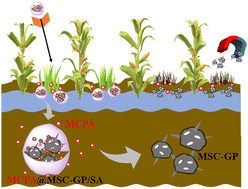
Semicoke (SC) is a kind of powder of industrial by-products that easily cause environmental pollution due to the presence of stable organic matter in clay minerals. In this work, a porous magnetic semicoke-based geopolymer (MSC-GP) was prepared using SC as the raw material. Then, 2-methyl-4-chlorophenoxyacetic acid (MCPA), a typical herbicide, was loaded into the porous MSC-GP and composited with sodium alginate (SA) using calcium as a crosslinking agent, which afforded MSC-GP/SA encapsulating MCPA (MCPA@MSC-GP/SA). The structure and micromorphology of SC, SC-GP and MCPA@MSC-GP/SA were characterized by FT-IR spectroscopy, TG-DTG, SEM and EDS. After measuring the swelling behavior in water and saline solutions, the water retention capacity, pH effect, degradation efficiency, site-specific targeted release, recovery, slow-release behavior, and pot experiments of MCPA@MSC-GP/SA were assessed. This indicated that the water retention capacity of soils was improved by the addition of MCPA@MSC-GP/SA. The release rate of the herbicide in MCPA@MSC-GP/SA was 65.2% in 90 days, which indicated that MCPA@MSC-GP/SA possessed a higher utilization efficiency and control of weeds compared to traditional herbicide. In summary, this study opens up a new avenue for improving the utilization efficiency of SC and prolonging the duration of herbicide action, which may have potential applications in agricultural production.
 Please wait while we load your content...


