


 PLATFORM UPDATE:


Preparation of C/Ho co-doped TiO2 for enhancing the photocatalytic degradation efficiency of tetracycline hydrochloride†
 *a
and
*a
and
Abstract
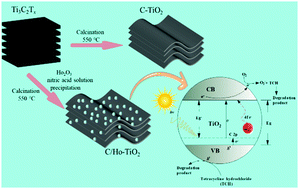
A C/Ho co-doped TiO2 catalyst was prepared by the precipitation–calcination method using Ti3C2Tx as the precursor and carbon source. X-ray diffractometry, transmission electron microscopy, X-ray photoelectron spectroscopy, N2 adsorption–desorption isotherms, UV-Vis diffuse reflectance spectroscopy, photoluminescence spectroscopy, and photoelectrochemical measurements were used for characterization. The C doped anatase TiO2 prepared by calcining Ti3C2Tx maintained the two-dimensional lamellar structure of the Ti3C2Tx precursor, and the carbon dopant was present on the surface of TiO2 in the form of C–O and C![[double bond, length as m-dash]](https://www.rsc.org/images/entities/char_e001.gif) O, whereas Ho3+ was mainly doped into the lattice of TiO2, forming Ho–O bonds with oxygen instead of Ti4+. The band gap of the C/Ho co-doped TiO2 photocatalyst was reduced as compared to that of pristine TiO2, which can improve the utilization efficiency of visible light. When the doping ratio of Ho was 5% (CHT-0.05), the photocatalyst had the highest photocurrent and degradation efficiency of tetracycline hydrochloride (86.4%). The reaction mechanism for the photocatalytic degradation of TCH by the C/Ho co-doped TiO2 photocatalyst was investigated and showed that superoxide radicals (˙O2−) and holes (h+) were the main species that influenced the results. The prepared photocatalyst had good catalytic performance over four cycles, and it was stable and suitable for wastewater treatment.
O, whereas Ho3+ was mainly doped into the lattice of TiO2, forming Ho–O bonds with oxygen instead of Ti4+. The band gap of the C/Ho co-doped TiO2 photocatalyst was reduced as compared to that of pristine TiO2, which can improve the utilization efficiency of visible light. When the doping ratio of Ho was 5% (CHT-0.05), the photocatalyst had the highest photocurrent and degradation efficiency of tetracycline hydrochloride (86.4%). The reaction mechanism for the photocatalytic degradation of TCH by the C/Ho co-doped TiO2 photocatalyst was investigated and showed that superoxide radicals (˙O2−) and holes (h+) were the main species that influenced the results. The prepared photocatalyst had good catalytic performance over four cycles, and it was stable and suitable for wastewater treatment.
 Please wait while we load your content...


