


 PLATFORM UPDATE:


A first-principles investigation of pressure induced topological phase transitions in half-Heusler AgSrBi
 a
Raghottam M.
Sattigeri,
a
Prafulla K.
Jha,
*a
Dominik
Kurzydlowski
b
and
Brahmananda
Chakraborty
c
a
Raghottam M.
Sattigeri,
a
Prafulla K.
Jha,
*a
Dominik
Kurzydlowski
b
and
Brahmananda
Chakraborty
c
Abstract
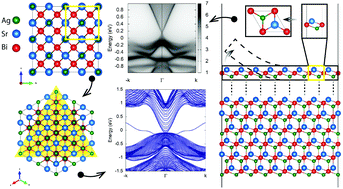
Topological insulators (TI) are materials with novel quantum states and exhibit a bulk insulating gap, while their edge/surface is conducting. This has been extensively explored in several half-Heusler (HH) compounds. In the present work we employ first-principles calculations based on density functional theory to perform thorough investigations of pressure induced topological phase transitions (TPT) in HH AgSrBi which belongs to the F![[4 with combining macron]](https://www.rsc.org/images/entities/char_0034_0304.gif) 3m space group. AgSrBi is intrinsically semi-metallic in nature which under isotropic pressure exhibits a semi-metal to trivial insulator transition while retaining the cubic symmetry. Also, we observe that this phase of AgSrBi is dynamically stable at extreme pressures as high as ∼23.5 GPa. However, on breaking the cubic symmetry we observe the much desired TI nature after a non-trivial phase transition from a semi-metal to TI. We also explore the effect of lowering the crystal symmetry along with dimensional confinement in realizing a two-dimensional (2D) TI, AgSrBi, which is done by cleaving the [111] crystal plane. We perform a qualitative analysis of the electronic properties to understand the origin of this non-trivial behavior in the bulk and 2D phases of AgSrBi. This is accompanied by a quantitative analysis of the
3m space group. AgSrBi is intrinsically semi-metallic in nature which under isotropic pressure exhibits a semi-metal to trivial insulator transition while retaining the cubic symmetry. Also, we observe that this phase of AgSrBi is dynamically stable at extreme pressures as high as ∼23.5 GPa. However, on breaking the cubic symmetry we observe the much desired TI nature after a non-trivial phase transition from a semi-metal to TI. We also explore the effect of lowering the crystal symmetry along with dimensional confinement in realizing a two-dimensional (2D) TI, AgSrBi, which is done by cleaving the [111] crystal plane. We perform a qualitative analysis of the electronic properties to understand the origin of this non-trivial behavior in the bulk and 2D phases of AgSrBi. This is accompanied by a quantitative analysis of the  invariants and surface/edge state spectra, which further confirms the TI nature of AgSrBi. Hence, we propose the bulk as well as 2D phase of AgSrBi as a dynamically stable TI which can be used as ultra-thin films for thermoelectric, spintronic and nanoelectronic applications.
 Please wait while we load your content...


