


 PLATFORM UPDATE:


A direct Z-scheme heterojunction g-C3N4/α-Fe2O3 nanocomposite for enhanced polymer-containing oilfield sewage degradation under visible light†
 ‡*a
‡*a
Abstract
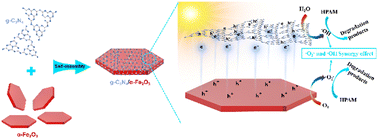
The massive discharge of polymer-containing sewage has caused more and more serious consequences to the petroleum production industry and ecological environment. To solve the above problem, constructing a Z-scheme heterojunction with effective charge transfer within the photocatalyst structure is critical in improving the performance of the catalytic reaction. A series of Z-scheme photocatalysts combining g-C3N4 and α-Fe2O3 were synthesized, and they exhibited high photocatalytic degradation HPAM efficiencies (up to 90%) without additional photosensitizers and sacrificial agents. The experiments have confirmed an efficient α-Fe2O3 to g-C3N4 electron transfer via strong electrostatic interaction, resulting in electron accumulation in g-C3N4 for H2O reduction to generate the active species ˙OH and holes in α-Fe2O3 for O2 oxidation to generate the active species ˙O2−; thus, ˙OH and ˙O2− synergistically catalyse HPAM degradation by mimicking natural photosynthesis. This study provides theoretical guidance for the efficient treatment of oilfield sewage using the photocatalytic technology.
 Please wait while we load your content...


