


 PLATFORM UPDATE:

Advancing the understanding of mainstream shortcut nitrogen removal: resource efficiency, carbon redirection, and plant capacity†
 *ab
Stephanie
Klaus,
a
*ab
Stephanie
Klaus,
a
Abstract
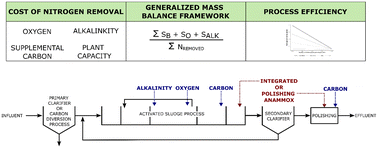
Mainstream shortcut nitrogen removal processes show potential for reducing operational costs, reducing carbon footprints, allowing increased carbon capture, and increasing treatment plant capacity. Shortcut nitrogen removal has been successful in sidestream applications where it is well documented and well understood. However, very little full-scale mainstream shortcut nitrogen removal operational or performance data exists. Both the presence of significant organic carbon in wastewater influent and the limitations of mainstream plant capacity alter the theoretical basis for the analysis of the benefits of shortcut nitrogen removal when applied to the mainstream. Extant literature frequently ignores the role of influent carbon and the discussion of capacity increases from anammox processes is absent. This study addresses both these gaps in the literature. Using a generalizable (process configuration agnostic) mass balance method for understanding nitrogen removal in mainstream conditions, we demonstrate that 1) the resource requirements (oxygen, carbon and alkalinity) of mainstream nitrogen removal processes are functions of the efficient use of influent COD for the reduction of oxidized nitrogen species. 2) The analysis of resource requirements provides the theoretical basis for understanding and quantifying potential upstream carbon capture, a significant driver for shortcut nitrogen removal implementation. Additionally, through simple kinetic modeling we show that 3) the reduction in required aerobic SRT provided by mainstream anammox processes can provide increased plant capacity, reduced design safety factors, or additional anoxic or anaerobic treatment volume, which can further enhance the beneficial use of influent carbon. Partial-nitrification anammox (PNA) and partial-denitrification anammox (PdNA) provide comparable reductions in oxygen, alkalinity, and carbon requirements, although the gain in resource efficiency between any nitrogen removal process diminishes as influent carbon is used more efficiently for nitrogen reduction. Nitrite shunt processes provide similar resource efficacy benefits, but do provide the capacity increase (reduced aerobic SRT requirements) afforded by PNA and PdNA.
- This article is part of the themed collection: Recent Open Access Articles - Environmental Science: Water Research & Technology
 Please wait while we load your content...


