


 PLATFORM UPDATE:

Efficient charge migration in TiO2@PB nanorod arrays with core–shell structure for photoelectrochemical water splitting†

Abstract
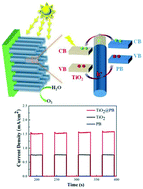
Herein, TiO2@Prussian-blue (PB) core–shell nanorod arrays for photoelectrochemical (PEC) applications were designed and prepared via a facile hydrothermal and electrodeposition process. Due to the combined merits of the anti-reflection structure of TiO2 nanorod arrays and broad light response of PB, the TiO2@PB film shows high light absorption efficiency. Additionally, the appropriate gradient energy gap of the core–shell heterostructure can promote photogenerated carrier separation and low electron–hole recombination rate. As a result, compared with TiO2 and PB films, the as-prepared TiO2@PB photoanode effectuates enhanced photocatalytic activity and the photocurrent density of TiO2@PB photoanode reaches 1.5 mA cm−2 at 1.23 V vs. RHE, which is approximately twice that of pristine TiO2 (0.75 mA cm−2). The introduction of the PB shell layer does not only improve light absorption ability but also enhances the photogenerated charge carrier's transfer and separation.
 Please wait while we load your content...


