


 PLATFORM UPDATE:

Efficient hydrogen production via sunlight-driven thermal formic acid decomposition over a porous film of molybdenum carbide†

Abstract
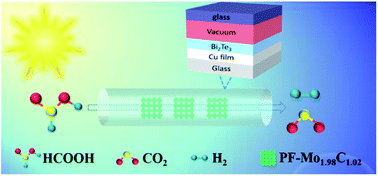
Discovering efficient and low CO selectivity non-noble heterogeneous catalysts toward formic acid (FA) dehydrogenation is vital for H2 energy systems. As a heating temperature is required to activate this reaction, the strategy of coupling a FA dehydrogenation reactor with a photothermal system possesses great potential for industrial applications. Herein, a sophisticated catalyst, a Mo1.98C1.02 porous film supported on carbon fiber paper, is demonstrated, with the advantages of a porous nanostructure, small nanoparticles and a carbon-supported structure simultaneously. The composite exhibits prominent thermal catalytic FA dehydrogenation, with a CO-free H2 generation rate of 0.79 L g−1 h−1 at 100 °C. Density functional theory calculations show that the formate route (*OCHOH → *OCOH + 1/2H2 → *OCO + 1/2H2 → CO2) is the minimum energy path for H2 and CO2 formation. Besides, a photothermal device was designed based on Bi2Te3/Cu, which can absorb and convert 1 kW m−2 irradiation into a high temperature of 240 °C, due to the high sunlight absorption, low heat conduction and low heat irradiation. Thus, a sunlight-driven thermal catalytic system was designed based on this device, with a H2 generation rate of 1.07 L g−1 h−1 under 0.25 kW m−2. This value is about two orders of magnitude faster than that of photocatalytic FA decomposition over reported non-precious photocatalysts. These results demonstrate that FA dehydrogenation can be realized under weak solar irradiation with the assistance of photothermal systems, facilitating industrial applications.
 Please wait while we load your content...


