


 PLATFORM UPDATE:


Selective hydrogenolysis of furfural into fuel-additive 2-methylfuran over a rhenium-promoted copper catalyst†
 c
Kajornsak
Faungnawakij,
c
Suttichai
Assabumrungrat,
de
Vorranutch
Itthibenchapong
c
and
Atthapon
Srifa
*a
c
Kajornsak
Faungnawakij,
c
Suttichai
Assabumrungrat,
de
Vorranutch
Itthibenchapong
c
and
Atthapon
Srifa
*a
Abstract
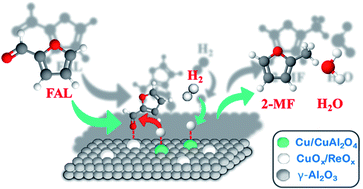
The effect of Re promoter on Cu/γ-Al2O3 catalysts with various Cu : Re molar ratios was comprehensively investigated in comparison to the monometallic Cu/γ-Al2O3 and Re/γ-Al2O3 catalysts. The combination of Re and Cu resulted in a difficulty in reduction behavior of the Cu species, as detected using hydrogen temperature-programmed reduction, indicating that the Re promoter had stronger metal–support interactions. The acidity, as confirmed by ammonia temperature-programmed desorption, increased with the Re loading. X-ray diffraction and X-ray absorption near edge structure measurements of the spent CuRe catalyst revealed the existence of metallic Cu, Cu2O, CuO, amorphous CuAl2O4, ReO3, and NH4ReO4. The as-synthesized catalysts without reduction were directly utilized for the hydrogenolysis of furfural (FAL) into the fuel additive 2-methylfuran (2-MF). The highest 2-MF yield (86.4%) was accompanied by a 10.4% 2-methyltetrahydrofuran (2-MTHF) yield using the optimal Cu1Re0.14 catalyst under the investigated conditions (200 °C, 6 h, and 20 bar H2). The kinetic study using furfuryl alcohol (FOL), a primary intermediate, revealed that the rate of 2-MF production for the optimal Cu1Re0.14 catalyst was faster than that of the Cu benchmark. These results indicated that a small amount of oxophilic Re species could promote the hydrogenolysis of the C–OH bond in FOL to form 2-MF due to the synergistic effect between the Cu and Re active species. In addition, the activity of the Cu1Re0.14 catalyst remained highly stable through four consecutive experiments.
 Please wait while we load your content...


