


 PLATFORM UPDATE:

The development of a highly selective fluorescent probe for the rapid detection of HClO in living cells and zebrafish†

Abstract
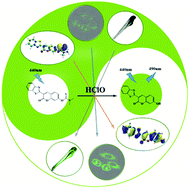
Hypochlorous acid (HClO) is a significant signaling species which plays a decisive role in the immune system as an excellent defense against invasive bacteria. Therefore, it is significant to monitor HClO accurately and quickly in organisms. Herein, a new turn-on fluorescent probe (BM-HA) with a simple structure for rapid sensing of HClO is presented. BM-HA has favorable properties, including high selectivity, a large turn-on fluorescence signal (140-fold), and fast response (about 15 s). Additionally, quantum chemical calculations with DFT and TDDFT proved that reduced fluorescence of the BM-HA probe was possible due to the a-PET effect and the non-coplanarity of the coumarin and the benzothiazole. Furthermore, imaging in living cells and zebrafish indicates that the probe can potentially be used to detect HClO in complex biosystems.
 Please wait while we load your content...


