


 PLATFORM UPDATE:


Highly luminescent and stable quasi-2D perovskite quantum dots by introducing large organic cations†

Abstract
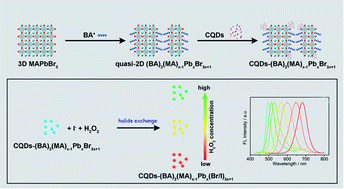
Herein, ultra-stable quasi-two-dimensional perovskite quantum dots (quasi-2D PQDs) are synthesized by introducing the butylamine cation (BA+) into the methylamine lead bromide perovskite (MAPbBr3). By reducing the dimensionality of the perovskite structure, the quasi-2D perovskite (BA)2(MA)x−1PbxBr3x+1 presents higher luminescence efficiency and better environmental stability than traditional 3D perovskites, which is mainly because the dimensionality-reduced perovskite has higher exciton binding energy and formation energy. Under an optimal MA : BA ratio of 1 : 1, the quasi-2D perovskite exhibits about four times higher luminescence efficiency (PLQY = 49.44%) than pristine MAPbBr3; meanwhile it emits stable luminescence in an environment with 80% humidity for 50 days. Most importantly, carbon quantum dot (CQD) doping has also been applied in this work, which effectively passivates the defects of (BA)2(MA)x−1PbxBr3x+1via H-bond interaction, further improving the stability of the perovskite in water. Inspired by the superior performances of the proposed quasi-2D nanomaterial, a novel colorimetric method based on halide ion exchange has been developed for H2O2 detection, which also demonstrates that PQDs show significant potential in the field of environmental monitoring.
 Please wait while we load your content...


