


 PLATFORM UPDATE:

Defect quantification in metal halide perovskites: the solid-state electrochemical alternative†

Abstract
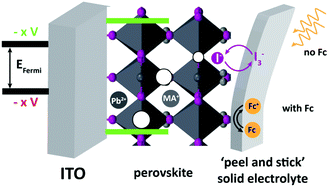
Electrochemical methodologies are routinely used to determine energetics and defect density in semiconductor materials under operando conditions. For metal halide perovskites, electrochemical methods are restricted to a limited group of non-solvent electrolytes. This challenge is circumvented via a ”peel and stick” solid electrolyte that can contain redox active species, is transparent to visible and X-ray photons for simultaneous characterizations, and can be removed for quantification of near-surface composition and energetics using photoelectron spectroscopies. Defects are qualified for both near-stoichiometric and over-stoichiometric MAPbI3 films using controlled hole and electron injection, afforded through potential modulation with respect to a calibrated internal reference. Inclusion of mid-gap redox probes (ferrocene) allows for probing density of states, whereby electron transfer reversibility is shown to be dependent upon the number of ionized defects at the perovskite's band edges. A detailed Coulombic analysis is provided for determination of defect energetics and densities, with a near-stoichiometric film exhibiting a defect density of ∼2 × 1017 cm−3 at 0.1 eV above the valence band. We predict that this easily implemented three-electrode platform will be translatable to operando characterization of a range of semiconductor materials, including thin film perovskites, (in)organic semiconductors, quantum dots, and device stacks, where the removable solid electrolyte functions as the “top contact”.
 Please wait while we load your content...


