


 PLATFORM UPDATE:

Two Cd(ii)-based metal–organic frameworks for the highly effective detection of Fe3+ ions and levofloxacin in aqueous media†

Abstract
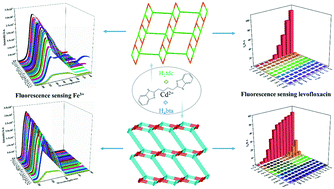
Levofloxacin (LVX), as a broad-spectrum antibiotic, is ubiquitous in water environments due to its wide application and good water solubility, posing a certain threat to the ecological environment. Therefore, it is necessary to design a fluorescent sensor with an effective detection ability. In this work, two new Cd(II)-based metal–organic frameworks (MOFs) [Cd(L)0.5(tdc)·H2O]n (1) and [Cd(L)0.5(btec)0.5]n (2) (L = 1,4-di(1H-benzo[d]imidazol-2-yl)butane, H2tdc = 2,5-thiophenedicarboxylic acid, H4btec = 1,2,4,5-benzenetetracarboxylic acid) were hydrothermally synthesized and characterized. 1 presents a 2D hierarchical layer with a 3,4L83 network, whereas 2 exhibits a 3D framework with fsh topology. The two Cd(II)-MOFs exhibit superior thermal and chemical stability (pH = 3–12). 1 and 2 can selectively identify LVX with ultra-high sensitivity (0.01 μM and 0.02 μM), rapid response (in 30 s) and excellent selectivity in water. Meanwhile, 1 and 2 also can be efficient probes for detection of Fe3+ ions with detection limits of 1.08 μM and 1.74 μM, respectively. Moreover, the two dual-response luminescent sensors exhibit remarkable reusability. The quenching mechanisms were also investigated from the perspective of energy transfer and photoinduced electron transfer (PET) in detail.
 Please wait while we load your content...


