


 PLATFORM UPDATE:

Urea-assisted synthesis of a Fe nanoparticle modified N-doped three-dimensional porous carbon framework for a highly efficient oxygen reduction reaction†

Abstract
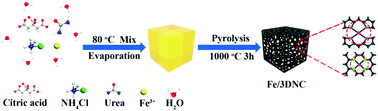
Transition metals and heteroatom doped porous carbon materials have become sone of the most promising catalyst candidates to replace noble metal catalysts for high efficiency oxygen reduction reactions (ORR). Currently, however, the widely used hard templating method for preparing such materials is often complicated and expensive. Here, we develop a rapid gas foaming process to prepare a novel Fe nanoparticle modified N-doped three-dimensional porous carbon framework (Fe/3DNC) catalyst with a controllable microscopic morphology and catalytic efficiency by regulating the amount of urea. It is found that the optimized Fe/3DNC-2 catalyst has a high specific surface area (438 m2 g−1), hierarchically porous structure and homogeneous distribution of active sites (pyridinic N, graphitic N and FeNX). Thanks to the unique 3D framework architecture, the Fe/3DNC-2 catalyst exhibits a remarkable activity and long-term durability towards the ORR, such as a half-wave potential (E1/2 = 0.874 V vs. RHE) and onset potential (EOnset = 0.995 V vs. RHE) which is more positive than that of a commercial noble metal catalyst (20% Pt/C, E1/2 = 0.848 V, EOnset = 0.973 V) in an alkaline medium, and a half-wave potential with only a slight negative shift of approximately 7 mV after 5000 cycles.
 Please wait while we load your content...


