


 PLATFORM UPDATE:

Facile C–N coupling of coordinated ammonia and labile carbonyl or acetonitrile promoted by a thiolate-bridged dicobalt reaction scaffold†

Abstract
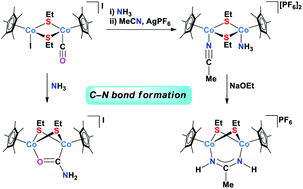
At low temperature, interaction of the thiolate-bridged dicobalt carbonyl complex [Cp*Co(I)(μ-SEt)2(CO)CoCp*][I] (Cp* = η5-C5Me5) (1) with NH3 resulted in the C–N coupling of the coordinated CO and amido group that originate from ammonia activation to afford a dicobalt formylamino complex [Cp*Co(μ-SEt)2(μ-η1:η1-O![[double bond, length as m-dash]](https://www.rsc.org/images/entities/char_e001.gif) CNH2)CoCp*][I] (2). Interestingly, at relatively high temperatures, the labile CO ligand was replaced by NH3 to give a thiolate-bridged dicobalt ammonia complex [Cp*Co(I)(μ-SEt)2(NH3)CoCp*][I] (3). Subsequently, in the presence of the dehalogenation reagent AgPF6, the Co2S2 scaffold can simultaneously activate NH3 and MeCN to produce the complex [Cp*Co(MeCN)(μ-SEt)2(NH3)CoCp*][PF6]2 (4). Furthermore, in the presence of NaOEt, the facile occurrence of the intramolecular cyclization led to the formation of acetamidino-bridged dicobalt complex [Cp*Co(μ-SEt)2(μ-η1:η1-NH(CCH3)NH)CoCp*][PF6] (5), which may proceed through the nucleophilic attack of amido from NH3 to coordinated MeCN followed by the hydrogen atom transfer process. In the presence of MeCN, treatment of 5 with HBF4 released the corresponding [MeC(NH2)NH2]BF4; meanwhile, the [Co2S2] core structural scaffold remained. In this Co2S2 reaction system, the cooperative activation effect between the two cobalt centers plays an important role for NH3 activation and functionalization.
CNH2)CoCp*][I] (2). Interestingly, at relatively high temperatures, the labile CO ligand was replaced by NH3 to give a thiolate-bridged dicobalt ammonia complex [Cp*Co(I)(μ-SEt)2(NH3)CoCp*][I] (3). Subsequently, in the presence of the dehalogenation reagent AgPF6, the Co2S2 scaffold can simultaneously activate NH3 and MeCN to produce the complex [Cp*Co(MeCN)(μ-SEt)2(NH3)CoCp*][PF6]2 (4). Furthermore, in the presence of NaOEt, the facile occurrence of the intramolecular cyclization led to the formation of acetamidino-bridged dicobalt complex [Cp*Co(μ-SEt)2(μ-η1:η1-NH(CCH3)NH)CoCp*][PF6] (5), which may proceed through the nucleophilic attack of amido from NH3 to coordinated MeCN followed by the hydrogen atom transfer process. In the presence of MeCN, treatment of 5 with HBF4 released the corresponding [MeC(NH2)NH2]BF4; meanwhile, the [Co2S2] core structural scaffold remained. In this Co2S2 reaction system, the cooperative activation effect between the two cobalt centers plays an important role for NH3 activation and functionalization.
 Please wait while we load your content...


