


 PLATFORM UPDATE:


In situ growth of chrysanthemum-like NiCo2S4 on MXenes for high-performance supercapacitors and a non-enzymatic H2O2 sensor†

Abstract
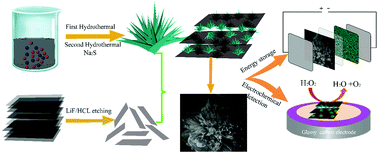
In this work, we developed a novel strategy to couple chrysanthemum-like NiCo2S4in situ-grown MXene hybrids into a three-dimensional (3D) sandwich architecture hybrid as an electrode material for high-performance asymmetric supercapacitors and non-enzymatic H2O2 sensors. In the 3D sandwich architecture hybrid, the NiCo2S4 particles were encapsulated by MXene layers, which enhanced the interlayer space of MXene, significantly improving the electrochemical properties. In particular, the MXene/NiCo2S4 1 : 2 electrode achieved a specific capacitance of 1266 F g−1 at 0.5 A g−1 and maintained 95.21% of its initial value after 10 000 cycles. Furthermore, an asymmetrical supercapacitor was also fabricated using MXene/NiCo2S4 1 : 2 as the positive electrode and activated carbon (AC) as the negative electrode (MXene/NiCo2S4 1 : 2//AC), which exhibited exceptional electrochemical performance. MXene/NiCo2S4 1 : 2//AC exhibited a large specific capacitance of 621 F g−1 at 0.5 A g−1 and energy density of 72.82 W h kg−1 at a power density of 0.635 kW kg−1. In addition, MXene/NiCo2S4 1 : 2 was employed as a non-enzymatic sensor for the electrochemical detection of H2O2, which exhibited a high sensitivity of 0.267 μA μM−1 cm−2 and noteworthy low detection limit of 0.193 μM based on 3 signal-noise ratios. This research provides a facile route for the in situ growth of bimetallic sulfides on MXenes as electrode materials for energy storage and electrochemical detection.
 Please wait while we load your content...


