


 PLATFORM UPDATE:

β-Cyclodextrin-based hollow nanoparticles with excellent adsorption performance towards organic and inorganic pollutants†

Abstract
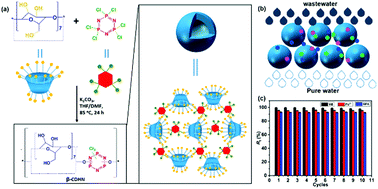
In this work, β-cyclodextrin (β-CD) based hollow nanoparticles (denoted as β-CDHN) with abundant active sites and high specific surface area were first fabricated via a facile one-step method. The β-CDHN presented a maximum adsorption capacity of 2080.35, 427.35 and 120.48 mg g−1 towards the cationic dye methylene blue (MB), heavy metal ions (Pb2+) and bisphenol A (BPA), respectively, much higher than those of many other adsorbents. Furthermore, β-CDHN also exhibited fast adsorption kinetics towards these pollutants with adsorption rate constants 6 to 200 times higher than those of activated carbon and other β-CD-based adsorbents, meaning the former can remove these pollutants at a much faster adsorption rate than the latter adsorbents. More importantly, the removal efficiency of these pollutants on β-CDHN almost remained stable after 10 regeneration cycles with favorable recyclability. The prepared β-CDHN show great potential in practical applications due to their low costs and high efficiency in the treatment of organic and inorganic pollutants from wastewater.
 Please wait while we load your content...


