


 PLATFORM UPDATE:


Systematic evaluation of lithium-excess polyanionic compounds as multi-electron reaction cathodes†
 *a
and
*a
and
Abstract
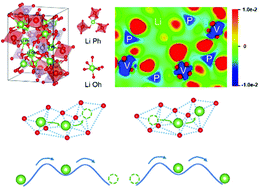
Polyanion cathodes with multi-electron redox always facilitate wider application in a metal ion-based battery system because of their high capacity and safety. However, the irreversible phase transformation and interfacial deterioration remain major impediments. Herein, using monoclinic Li3V2(PO4)3 as a model, the impact of excess lithium on its electrochemical properties are demonstrated. It was determined that a maximum of 5% excess lithium could be incorporated into the monoclinic structure, and a further overdose of lithium led to the formation of secondary phase Li3PO4. The excess Li+ ions are located at both octahedral and interstitial sites, which enable enhanced redox kinetics that are mainly attributed to accelerated ionic movement induced by alternate diffusion behavior of Li+ ions in a three-dimensional permeation path. Moreover, Li-excess local configurations can stabilize the lattice oxygen and provide a favorable cathode–electrolyte interface, which synergistically relieves the structural degradation during electrochemical cycling, thus guaranteeing exceptional cycling stability (e.g., 82.5% after 1000 cycles at 1000 mA g−1). These findings provide a comprehensive understanding of defect/electronic structure/ion transport and the intrinsic properties of polyanionic Li3V2(PO4)3 and may help to pave the way for other highly stable electrodes for rechargeable batteries.
 Please wait while we load your content...


