


 PLATFORM UPDATE:


Synthesis of high surface area transition metal sponges and their catalytic properties
 *ab
Dino
Villagran
ab
and
*ab
Dino
Villagran
ab
and
Abstract
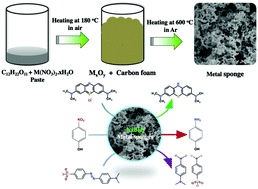
We have reported sucrose-mediated facile route for the preparation of high surface area cobalt (Co), nickel (Ni), and copper (Cu) sponges. Scanning electron microscopy (SEM) and transmission electron microscopy (TEM) revealed the sponge-like and nanoparticle-like morphologies of the metal sponges. The catalytic activity of the metal sponges was studied via the reduction of organic pollutants, including 4-nitrophenol (4-NP), methyl orange (MO) and methylene blue (MB) in water. It was found that the Cu sponge exhibited the fastest rate for the reduction of 4-NP, MO, and MB, followed by the Co and Ni sponges, respectively. The metal sponges exhibited excellent catalytic stability for the reduction of 4-NP for multiple cycles. In addition, due to their magnetic properties, the Co and Ni sponges could be easily recovered and reused by applying an external magnetic field.
 Please wait while we load your content...


