


 PLATFORM UPDATE:

Enhancement and mechanism of nano-BaTiO3 piezocatalytic degradation of tricyclazole by co-loading Pt and RuO2†
 *a
and
*a
and
Abstract
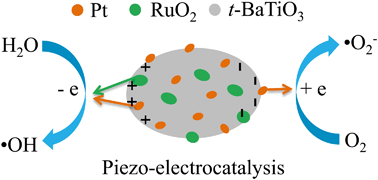
Two electrocatalysts Pt and RuO2 were directionally co-loaded on the nano-piezomaterial t-BaTiO3 by a two-step process: the alkali deposition–oxidation of RuO2 followed by the selective photo-reduction deposition of Pt. It was found that both Pt and RuO2 could considerably improve the piezo-degradation efficiency of t-BaTiO3 for pollutants. For the biorefractory pesticide tricyclazole, RuO2/t-BaTiO3/Pt possessed a piezo-degradation kinetic constant of 0.032 min−1. The rate constant was 3.11, 2.56 and 2.58 times that of t-BaTiO3, Pt/t-BaTiO3 and RuO2/t-BaTiO3, respectively. Moreover, the rate constant of RuO2/t-BaTiO3/Pt was greater than the sum (0.025 min−1) of the rate constants of two single-loaded materials, Pt/t-BaTiO3 and RuO2/t-BaTiO3. This indicates that co-loaded Pt and RuO2 in RuO2/t-BaTiO3/Pt have a synergistic enhancement effect on the piezo-degradation. By analyzing the kind and amount of the reactive oxygen species (˙OH, 1O2, ˙O2− and H2O2) from these nano-piezocatalytic systems, it was inferred that Pt acted as a cathodic- and anodic-like catalyst while RuO2 acted as an anodic-like catalyst. The mechanism of the synergistic catalysis for co-loaded Pt and RuO2 was similar to the principle of an electrolytic reactor, in which Pt and RuO2 were its two catalytic nano-electrodes and the power was from the piezo-potential of t-BaTiO3.
 Please wait while we load your content...


