


 PLATFORM UPDATE:

Bioluminescent probe for detecting endogenous hypochlorite in living mice†
 *ac
*ac
Abstract
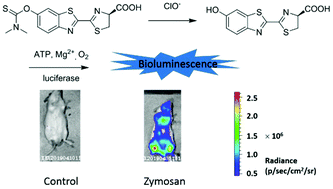
As a kind of biologically important reactive oxygen species (ROS), hypochlorite (ClO−) plays a crucial role in many physiological processes. As such, endogenous ClO− is a powerful antibacterial agent during pathogen invasion. Nonetheless, excessive endogenous ClO− could pose a health threat to mammalian animals including humans. However, the detection of endogenous ClO− by bioluminescence probes in vivo remains a considerable challenge. Herein, based on a caged strategy, we developed a turn-on bioluminescent probe 1 for the highly selective detection of ClO−in vitro and imaging endogenous ClO− in a mouse inflammation model. We anticipate that such a probe could help us understand the role of endogenous ClO− in a variety of physiological and pathological processes.
 Please wait while we load your content...


