


 PLATFORM UPDATE:

Thermal-induced surface defective Co/Fe–Co planar hybrid composite nanosheet with enhanced catalytic activity in the Fenton-like reaction†
Abstract
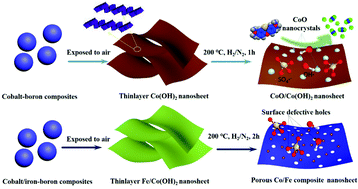
Surface defective or heterojunction sites of catalysts generally afford remarkable catalytic activity thanks to their high-surface-energy. Regularly-generating multiple defective sites on the surface of a catalyst is exceedingly promising in many reactions. In this study, we report an unexpected Co/Fe–Co planar hybrid composite nanosheet with serried surface defects including surface biphasic junction sites or defective holes. A facile thermal-induced process was applied to trigger the generation of defective sites on planar Co/Fe–Co hydroxides. Through a controlled thermal process, massive serried CoO nanocrystals were in situ dissolved out of the surface of cobalt hydroxide, while defective surface holes were formed on the Fe-doped Co(OH)2 nanosheets under a prolonged thermal procedure. The morphology and microscale structure of the resulting Co/Fe–Co hybrid 2-dimensional (2D) composites were systematically examined by virtue of various characterization techniques. As expected, the obtained surface defective Co/Fe–Co planar composites showed obviously enhanced catalytic activity in the Fenton-like reaction. Based on a catalytic study, we proved that the CoO nanocrystals densely-distributed on thinlayer Co(OH)2. Uniformly-introduced Fe heteroatoms in the inter-structure of Co(OH)2, along with the formed surface defective holes on Fe–Co hybrid composites, are synergistically responsible for increased catalytic removal efficiency of MB in the presence of peroxomonosulfate.
 Please wait while we load your content...


