


 PLATFORM UPDATE:


The effect of the disposition of coordinated oxygen atoms on the magnitude of the energy barrier for magnetization reversal in a family of linear trinuclear Zn–Dy–Zn complexes with a square-antiprism DyO8 coordination sphere†
 *a
and
*a
and
Abstract
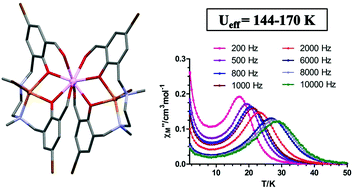
A series of trimetallic Zn–Dy–Zn complexes of the general formula [ZnX(μ-L)Dy(μ-L)XZn]Y·nS, where H2L is the compartmental ligand N,N′-dimethyl-N,N′-bis(2-hydroxy-3-formyl-5-bromobenzyl)ethylenediamine, X is the coligand (X = Cl, Br, I and N3), Y is the counteranion and S are the crystallization solvent molecules have been synthesized and magnetically characterized. In all these complexes, the Dy(III) ions exhibit DyO8 coordination environments with a slightly distorted square-antiprism D4d symmetry. Due to the disposition of the oxygen atoms around the Dy(III) ions, large easy-axis anisotropy is expected, which is responsible for the high thermal energy barriers for the reversal of the magnetization observed at zero field (in the 144–170 K range for all complexes). A preliminary correlation between the disposition of the oxygen atoms of the ligand (phenoxo and aldehyde) in the DyO8 coordination sphere and the value of Ueff has been established.
 Please wait while we load your content...


