


 PLATFORM UPDATE:

An uncommon 3D 3,3,4,8-c Cd(ii) metal–organic framework for highly efficient luminescent sensing and organic dye adsorption: experimental and theoretical insight†

Abstract
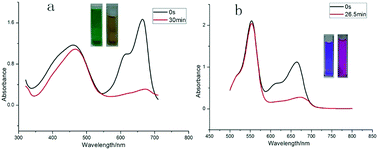
A new Cd(II) based metal–organic framework (MOF), having formula {(CH3)2NH2)6[Cd5(L)4]·H2O·3DMF}n (1), has been synthesized based on a rigid tetracarboxylate ligand of terphenyl-3,3′′,5,5′′-tetracarboxylic acid (H4L). 1 shows a complicated 3D tetranodal 3,3,4,8-c network with uncoordinated –COO− groups. The highly selective luminescent sensing of 2,4-dinitrophenol (2,4-DNP), 2,4,6-trinitrophenol (TNP) and ferric ions was studied for 1 through the alleviation in its fluorescence intensity. The detection limit of 2,4-DNP was found to be 0.84 ppm, which is 20 times higher than that of 1,3,5-trimethylbenzene, demonstrating greater and selective quenching ability. The possible mechanism associated with the decrease in fluorescence intensity of 1 in the presence of nitroaromatics (NACs) has been addressed by theoretical calculations. Furthermore, 1 displays excellent capacity to adsorb methylene blue (MB) with high selectivity, and it maintains an almost identical adsorption performance after being recycled five times.
 Please wait while we load your content...


