


 PLATFORM UPDATE:

Syntheses, structures, and magnetic properties of two series of copper-lanthanide heterometallic coordination polymers based on pyridine-2,3-dicarboxylic acid and succinic acid†
 *a
*a
Abstract
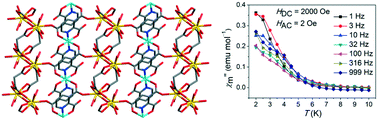
Two series of copper-lanthanide heterometallic coordination polymers (CPs), [LnCu(2,3-pydc)2(suc)0.5(H2O)3]·H2O [Ln = La (I), Pr (II), Nd (III), Sm (IV), Gd (V), and Eu (VI), 2,3-H2pydc = pyridine-2,3-dicarboxylic acid, H2suc = succinic acid], [Ln2Cu3(2,3-pydc)6(H2O)10]·8H2O [Ln = Eu (VII), Tb (VIII), Dy (IX), and Er (X)], [Ln2Cu(2,3-pydc)2(suc)(μ2-OH)2(H2O)2]·2H2O [Ln = Er (XI), Yb (XII), and Lu (XIII)], [Ln2Cu(2,3-pydc)2(suc)2(H2O)6]·2H2O [Ln = Sm (1), Eu (2), Gd (3), Tb (4), Dy (5), and Er (6)], and Ln2Cu(2,3-pydc)2(suc)2(H2O)2 [Ln = Er (7), Yb (8), and Lu (9)], were successfully synthesized by the hydrothermal reactions of Cu(NO3)2·3H2O, LnCl3·nH2O, 2,3-H2pydc, and H2suc. CPs 1–9 show two types of similar two-dimensional (2D) structures. In 1–9, the 2,3-pydc anions bridge the CuII ions into a one-dimensional (1D) loop chain, and the suc anions link the LnIII ions into a 1D double chain. The 1D loop chains and the 1D double chains connect each other to generate a 2D layer. The adjacent 2D layers are further packed into a three-dimensional (3D) supramolecular architecture by hydrogen-bonding interactions. CPs 4 and 6 display ferromagnetic interactions between the paramagnetic centers, and CP 5 shows a field-induced slow magnetic relaxation behavior. The structures and magnetic properties of I–XIII have been reported in previous work (Eur. J. Inorg. Chem., 2016, 1060).
 Please wait while we load your content...


