


 PLATFORM UPDATE:

A macroscopic three-dimensional tetrapod-separated graphene-like oxygenated N-doped carbon nanosheet architecture for use in supercapacitors†
Abstract
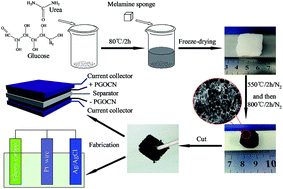
Macroscopic three-dimensional oxygenated carbon materials with enriched nitrogen (designated as PGOCN) are prepared by a two-step solid-state pyrolysis of a mixture of urea and glucose inside a template framework of melamine sponge in a N2 atmosphere without any functionalizing or crosslinking agents. Characterization by SEM, TEM, XPS and nitrogen adsorption–desorption isotherm measurements reveals that the prepared samples consist of a tetrapod framework embedded with crumpled graphene-like oxygenated N-doped carbon nanosheets, demonstrating a hierarchical porous structure of macro-, meso- and micropores. Considering the hierarchical porous structure combined with the presence of abundant oxygen and nitrogen as well as high electrical conductivity, the application of the PGOCN materials in high-performance supercapacitors is investigated. In three-electrode systems, the PGOCN electrodes show high specific capacitances of 348 F g−1 in acidic electrolytes and 308 F g−1 in alkaline electrolytes at a current density of 1 A g−1, respectively. Remarkably, the PGOCN materials can be directly cut into thin sheets to assemble two-electrode supercapacitor devices without adding binders and conducting additives using 6 M KOH as the electrolyte. The two-electrode supercapacitor device exhibits a high specific capacitance of 220 F g−1 at 0.2 A g−1 and a power density of 1.2 kW kg−1 at an energy density of 3.4 Wh kg−1 as well as outstanding cycling stability after 2000 cycles. The facile and low-cost preparation procedure combined with excellent electrochemical performance indicates that the developed materials have great potential for applications in energy storage devices such as supercapacitors.
 Please wait while we load your content...


