


 PLATFORM UPDATE:

Membrane aeration as an energy-efficient method for supplying oxygen to microbial fuel cells
Abstract
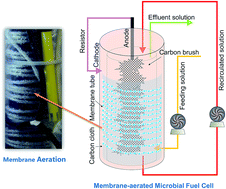
An active supply of oxygen will help with electricity generation in microbial fuel cells (MFCs). Although air-cathode MFCs have been developed to eliminate aeration, the MFCs with active aeration could have their niches in system scaling up and/or removal of certain contaminants that require oxygen in the cathode. In this study, an alternative aeration method based on a gas-transfer membrane has been investigated for MFC applications, in comparison with diffused aeration. The membrane-aerated microbial fuel cell (MAMFC) achieves a maximum coulombic efficiency (CE) of 55.4%, a current density of 17.3 A m−3 and COD removal efficiency of >61%. The CE of the MAMFC is higher than that of the diffused aeration MFC (DAMFC), indicating a higher conversion efficiency of substrate to electricity with membrane aeration. At the similar dissolved oxygen level of 6.61 mg O2 L−1, the MAMFC requires an energy input of 0.05 kW h m−3, significantly lower than 1.76 kW h m−3 by the DAMFC. Although both MFCs have negative energy balances under the testing conditions, the MAMFC could theoretically save 588–3485% of energy compared with the DAMFC. This study demonstrates that membrane aeration could be an energy efficient method for providing an active oxygen supply for MFC applications.
 Please wait while we load your content...


