


 PLATFORM UPDATE:

Mesoporous RuO2/TiO2 composites prepared by cyclodextrin-assisted colloidal self-assembly: towards efficient catalysts for the hydrogenation of methyl oleate†
Abstract
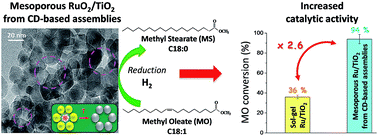
Mesoporous RuO2/TiO2 composites were prepared using a template-directed colloidal self-assembly approach combined with a cyclodextrin (CD)-assisted aqueous impregnation method. The supramolecular assemblies formed between the randomly methylated β-cyclodextrin (RaMeβ-CD) and the block copolymer P123 acted as a template for the formation of a highly porous TiO2 network over which uniform dispersion of ruthenium nanoparticles was achieved. By combining dynamic light scattering, X-ray diffraction, N2-adsorption, temperature-programmed reduction, field-emission scanning electron microscopy and high-resolution transmission electron microscopy, we show that CD-based assemblies provide a versatile and easily accessible toolbox with different functionalities for generating metal-supported catalysts with controlled pore architecture and uniform metal distribution. The performance of these supported catalysts was evaluated in the liquid phase hydrogenation of methyl oleate (MO, C18:1) to methyl stearate (MS, C18:0). Control of ruthenium dispersion into the large pores of RaMeβ-CD-P123-templated TiO2 material enhanced catalyst activity and selectivity for the hydrogenation of the internal C![[double bond, length as m-dash]](https://www.rsc.org/images/entities/char_e001.gif) C bond and permitted catalyst separation and reuse without loss of activity. Our findings highlight the pivotal role played by the CD-based assemblies on the performance of supported ruthenium catalysts.
C bond and permitted catalyst separation and reuse without loss of activity. Our findings highlight the pivotal role played by the CD-based assemblies on the performance of supported ruthenium catalysts.
 Please wait while we load your content...


