


 PLATFORM UPDATE:

New insights into binding interaction of novel ester-functionalized m-E2-m gemini surfactants with lysozyme: a detailed multidimensional study
Abstract
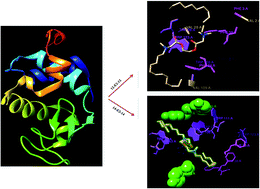
In this article fluorescence spectroscopy, UV-visible spectroscopy, circular dichroism (CD), isothermal titration calorimetry (ITC), transmission electron microscopy (TEM) and molecular docking methods have been used to examine the interaction between dicationic ester-bonded gemini surfactants (m-E2-m) and hen egg white lysozyme (HEWL). The fluorescence and UV-visible absorption spectral measurements indicate m-E2-m–HEWL complex formation via static procedure. Binding isotherms reveal mainly cooperative binding of m-E2-m surfactants to HEWL. Circular dichroism, and pyrene fluorescence depict conformational changes in HEWL upon m-E2-m combination. Synchronous fluorescence shows that addition of m-E2-m has a remarkable effect on the micropolarity of aromatic residues (Tyr/Trp) of HEWL. Far-UV CD spectra demonstrate that the α-helical network of HEWL is disrupted and its content decreases from 30.68% to 20.83%/20.40%, respectively, upon 12-E2-12/14-E2-14 combination. ITC confirms the endothermicity of m-E2-m–HEWL interactions while slight exothermicity was observed in the 14-E2-14–HEWL system at higher molar ratios of surfactant. TEM micrographs reveal structural change in HEWL upon m-E2-m addition. Molecular docking illustrates that 14-E2-14 binds principally near to predominant fluorophores of lysozyme viz. Trp-108 and Trp-62 while 12-E2-12 binds in proximity of Trp-123. This study provides an important insight, particularly the contribution of Trp-123 in the fluorescence besides already known predominant fluorophores, Trp-62 and Trp-108. Moreover, this study would be significant in context of protein–surfactant interactions in terms of special m-E2-m molecular structure, which is essential in determining their future use as excipients in pharmaceutical/drug delivery related compilations.
 Please wait while we load your content...


