


 PLATFORM UPDATE:


Controllable synthesis of In2O3 octodecahedra exposing {110} facets with enhanced gas sensing performance†
Abstract
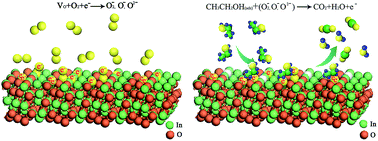
In2O3 octodecahedra have been successfully prepared by annealing the 18-facet In(OH)3 precursor. The as-prepared In2O3 polyhedra inherit the morphology of the In(OH)3 precursor and expose twelve {110} and six {100} facets. Gas sensing tests show that octodecahedron-based In2O3 sensor exhibits a sensitivity of 610 to 1000 ppm ethanol, which is 2.3-fold and 5.5-fold enhancement compared with cube- and particle-based sensor, respectively. The XPS results demonstrate that the {110} and {100} facets of In2O3 octodecahedra provided more oxygen vacancies than either the cubes exposing only {100} facets or the irregular particles. More oxygen vacancies would contribute to the enhancement of gas sensing performance. The crystal facet analysis of In2O3 octodecahedra show that high energy {110} facets could be easier to form oxygen vacancy than that of {100} facets, which could be the main reason for high gas sensing property. This finding will open a door to the design of high performance gas sensor, and the results are also beneficial to other fields such as energy conversion, environmental protection.
 Please wait while we load your content...


