


 PLATFORM UPDATE:

High Curie temperature and coercivity performance of Fe3−xCrxSe4 nanostructures†
Abstract
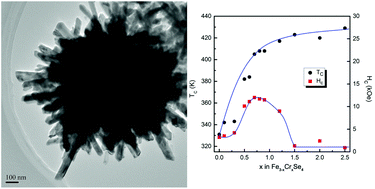
Monoclinic Fe3−xCrxSe4 nanostructures (0 ≤ x ≤ 2.5) were synthesized using a high-temperature solution chemical method. With increasing the Cr doping, the peak positions in the X-ray diffraction (XRD) patterns of Fe3−xCrxSe4 nanostructures slightly shifted to lower 2θ values due to the changes in lattice parameters. Expansions in the unit cell volumes of Fe3−xCrxSe4 nanostructures (x > 0.3) may have been responsible for enhancing the ferromagnetic (FM) interaction between magnetic ions, which resulted in a significant increase in the Curie temperature (TC) from 331 K for Fe3Se4 to 429 K for FeCr2Se4, distinctly differing from the magnetic properties of the corresponding bulk materials. A room-temperature coercivity (HC) analysis showed an obvious increase from 3.2 kOe for Fe3Se4 to 12 kOe for Fe2.3Cr0.7Se4 nanostructure, but gradually decreased upon further increasing the Cr content.
 Please wait while we load your content...


